Tuesday, May 7, 2013
Process Presentation
In the last part of my project I need to do a presentation of Wearing's Process. A lot of this process is covered in my other post, but I need to incorporate some visual. In order to accomplish this I need to dissect each part of this process piece by piece. For every step of the process I plan to have some sort of visual representation. Whether it be a visual of Wearings own work, or another work which uses the same process of Wearing. With this imagery I will create a slide show which goes through the process in the order Wearing does. Each step will be explained verbally, and visually, allowing each person to gain an understanding for how the project is I am not a visual artist and any idea I can think off, silicone casting, sculpting, or photography involves materials I do not have access to. I think this mode of visually representation should suffice for my assignment.

Research Component
For my final project I chose to do an artist who was not mentioned in my last blog post. The artist's name is Gillian Wearing and I discovered her through the always helpful google. I stumbled upon an article in The Times magazine in which Wearing was referred to as one of the most artist of the modern day. Looking further into her work I was intrigued. To me her most standout piece was Self Portrait as my Brother out of her Album series. This is a photo that stars Wearing wearing a complete silicone body suit made to look exactly like her brother.
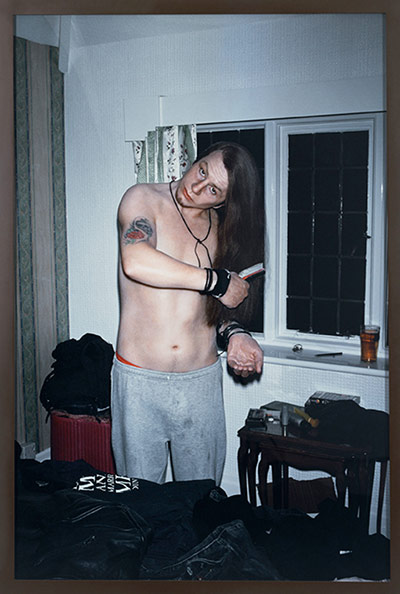
Above is the photo. In order to create my paper I need to find enough resources to understand exactly how Wearing makes the suit and takes the photo. This process has proved to me much longer than I ever expected. To help me begin my research I found an step by step tutorial by Wearing herself going through certain aspects of her process:
http://www.guardian.co.uk/artanddesign/gallery/2012/mar/27/gillian-wearing-takeover-mask#/?picture=387780737&index=7
In this link Wearing goes through what she has to do at each step. She speaks about how she must make a silicone cast of herself and well as the person she is trying to inhabit. She also talks about where she got the original photo of her brother and how the piece she is making is made to be an exact replica of a photo that her mom took in the 90's.
http://www.mattlippiatt.co.uk/Gillian%20Wearing%20extended.htm
This is another link I am going to use in my paper. It contains an interview with Wearing where she talks about the connotation of the piece. She tells the inerviewer that she feels as if she forms certain bonds with others and she feels a part of them inside herself, that is the message the photo is sending. There are parts of others inside us all.
http://www.guggenheim-bilbao.es/en/guia-educadores/gillian-wearing-self-portrait-as-my-uncle-bryan-gregory-2003/#activities
In this link a bit more about Wearings process is revealed. This link states that the process begins with the sculpture, and also talks about the team of artist Wearing must hire in order to help her create her mask and the sculptures. The price of each piece and the amount of time it takes to create them is also revealed
http://www.vanessa-pooley-bronze-sculptures.com/how-to-make-a-sculpture.html
https://www.stanwinstonschool.com/videos/how-to-life-cast-character-creation-tutorial
http://www.youtube.com/watch?v=M400dj19nUs
These are three links that are all step by step tutorials on how to complete a specific part of Wearing's process, including the materials and methods needed. One is on making clay sculptures, the next is one life casting, which is creating a silicone mold of a person and the final link is on basic silicone casting
http://www.contemporary-magazines.com/profile55.htm
This last like I plan to use helps to infer how the two silicone pieces and made into one ultimate body suit or mask. It speaks vaguely about a combining off the two molds to create a final product in which the interior is a mold of Wearing's body, but the outside is a replica of the clay model of her brother.
Above is the photo. In order to create my paper I need to find enough resources to understand exactly how Wearing makes the suit and takes the photo. This process has proved to me much longer than I ever expected. To help me begin my research I found an step by step tutorial by Wearing herself going through certain aspects of her process:
http://www.guardian.co.uk/artanddesign/gallery/2012/mar/27/gillian-wearing-takeover-mask#/?picture=387780737&index=7
In this link Wearing goes through what she has to do at each step. She speaks about how she must make a silicone cast of herself and well as the person she is trying to inhabit. She also talks about where she got the original photo of her brother and how the piece she is making is made to be an exact replica of a photo that her mom took in the 90's.
http://www.mattlippiatt.co.uk/Gillian%20Wearing%20extended.htm
This is another link I am going to use in my paper. It contains an interview with Wearing where she talks about the connotation of the piece. She tells the inerviewer that she feels as if she forms certain bonds with others and she feels a part of them inside herself, that is the message the photo is sending. There are parts of others inside us all.
http://www.guggenheim-bilbao.es/en/guia-educadores/gillian-wearing-self-portrait-as-my-uncle-bryan-gregory-2003/#activities
In this link a bit more about Wearings process is revealed. This link states that the process begins with the sculpture, and also talks about the team of artist Wearing must hire in order to help her create her mask and the sculptures. The price of each piece and the amount of time it takes to create them is also revealed
http://www.vanessa-pooley-bronze-sculptures.com/how-to-make-a-sculpture.html
https://www.stanwinstonschool.com/videos/how-to-life-cast-character-creation-tutorial
http://www.youtube.com/watch?v=M400dj19nUs
These are three links that are all step by step tutorials on how to complete a specific part of Wearing's process, including the materials and methods needed. One is on making clay sculptures, the next is one life casting, which is creating a silicone mold of a person and the final link is on basic silicone casting
http://www.contemporary-magazines.com/profile55.htm
This last like I plan to use helps to infer how the two silicone pieces and made into one ultimate body suit or mask. It speaks vaguely about a combining off the two molds to create a final product in which the interior is a mold of Wearing's body, but the outside is a replica of the clay model of her brother.
Monday, April 22, 2013
Art final considerations
Over the next couple of weeks I have to embark on a project that involves responding to a specific piece of artwork and then attempting to recreate the artistic process in which it was made in a way everyone can understand. For this project there are a variety of art forms I can choose from. The types I've been considering so far include video editing, street art, illustration and sculpting. Below are a few of my ideas.
The first artist/artwork I've been thinking about is Sheep in Wolves Clothing by Sachin Teng. The illustration is featured here:

To Teng, artwork is "the original subliminal message" so to start an illustration, he thinks of a message. That thought process is the first part of his artistic process, and Teng himself explains this idea of his on his website's Bio Section. For many of his pieces, Teng uses Photoshop as well as his own illustrations. He describes exactly how he does this step-by-step in a Photoshop tutorial that can be found online: http://www.digitalartsonline.co.uk/tutorials/photoshop/surreal-mixed-media-illustration/
This link is also useful because not only does Teng explain the process by which he uploads several different illustrations onto Photoshop and the combine them to create this grand imagine, he also explains the underpinnings of the relevant concepts behind the piece I have chosen.
As useful as this link it leaves out an important part in Teng's process that I plan to draw attention to in my own paper, and that is creating the actual illustration. I have to consider the tools he uses and why he uses them. Luckily, Teng is not shy and elaborates on the materials he uses in an with The Observer
Another Artist I am considering is a street artist by the name of Blu
His art involves both a form of painting using spray paint as well as video editing known as stop motion animation, in which he takes a series of several photos of an art piece, each time changing the artwork ever so slightly, and then combining each photo into a video creating the illusion that the artwork is moving. There is a documentary called "Big Bang Big Boom" which documents every step of this process. The video can be found on several places online. Here is one link to the Video. Another link which contains several videos about the importance of patience and reproduction in blu's art process is here.
Blu is of course an alias, in order to keep the identity of the artist a secret so of course first hand accounts on exactly how blu creates an image are almost impossible to find. However, looking up simple "how to" videos and papers on stop-motion animation as well as graffiti can be very helpful in understanding how Blu does what he or she does. Here a couple useful links on stop motion
http://content.photojojo.com/tutorials/stop-motion-digital-camera/
http://digital-photography-school.com/5-tips-for-making-a-stop-motion-video
And here is a link on creating graffiti
http://teamtreehouse.com/library/exercise-your-creative/how-to-create-a-graffitistyle-logo
This link will allow me to help explain and possible recreate (on a small scale) blu's process for my class.
The last piece I am considering is an untitled porcelain sculpture by Maria Rubinke
A bit of a background on Rubinke, what inspires her artwork and a bit on how exactly she creates is can all be found in an online biography.
Ceramic sculpting is a process that is usually going to be the same for pretty much whoever does it. A few videos and links which can help understand exactly how this is done can be found all over the internet
This video shows how to make porcelain figurines very similar to the ones showcased by Rubinke
This link shows explains with text different tips and techniques to creating ceramics sculptures:
http://ceramicartsdaily.org/category/ceramic-art-and-artists/ceramic-sculpture/
The first artist/artwork I've been thinking about is Sheep in Wolves Clothing by Sachin Teng. The illustration is featured here:
To Teng, artwork is "the original subliminal message" so to start an illustration, he thinks of a message. That thought process is the first part of his artistic process, and Teng himself explains this idea of his on his website's Bio Section. For many of his pieces, Teng uses Photoshop as well as his own illustrations. He describes exactly how he does this step-by-step in a Photoshop tutorial that can be found online: http://www.digitalartsonline.co.uk/tutorials/photoshop/surreal-mixed-media-illustration/
This link is also useful because not only does Teng explain the process by which he uploads several different illustrations onto Photoshop and the combine them to create this grand imagine, he also explains the underpinnings of the relevant concepts behind the piece I have chosen.
As useful as this link it leaves out an important part in Teng's process that I plan to draw attention to in my own paper, and that is creating the actual illustration. I have to consider the tools he uses and why he uses them. Luckily, Teng is not shy and elaborates on the materials he uses in an with The Observer
Another Artist I am considering is a street artist by the name of Blu
His art involves both a form of painting using spray paint as well as video editing known as stop motion animation, in which he takes a series of several photos of an art piece, each time changing the artwork ever so slightly, and then combining each photo into a video creating the illusion that the artwork is moving. There is a documentary called "Big Bang Big Boom" which documents every step of this process. The video can be found on several places online. Here is one link to the Video. Another link which contains several videos about the importance of patience and reproduction in blu's art process is here.
Blu is of course an alias, in order to keep the identity of the artist a secret so of course first hand accounts on exactly how blu creates an image are almost impossible to find. However, looking up simple "how to" videos and papers on stop-motion animation as well as graffiti can be very helpful in understanding how Blu does what he or she does. Here a couple useful links on stop motion
http://content.photojojo.com/tutorials/stop-motion-digital-camera/
http://digital-photography-school.com/5-tips-for-making-a-stop-motion-video
And here is a link on creating graffiti
http://teamtreehouse.com/library/exercise-your-creative/how-to-create-a-graffitistyle-logo
This link will allow me to help explain and possible recreate (on a small scale) blu's process for my class.
The last piece I am considering is an untitled porcelain sculpture by Maria Rubinke

http://hifructose.com/2013/04/16/maria-rubinkes-grotesque-ceramic-sculptures/
Preceding this text is a link to an online magazine which documents the thought process that goes into each of Rubinke's sculptures.A bit of a background on Rubinke, what inspires her artwork and a bit on how exactly she creates is can all be found in an online biography.
Ceramic sculpting is a process that is usually going to be the same for pretty much whoever does it. A few videos and links which can help understand exactly how this is done can be found all over the internet
This video shows how to make porcelain figurines very similar to the ones showcased by Rubinke
This link shows explains with text different tips and techniques to creating ceramics sculptures:
http://ceramicartsdaily.org/category/ceramic-art-and-artists/ceramic-sculpture/
Wednesday, April 10, 2013
Parody in Postmodern Art
In postmodern artwork there has been several types of themes which revolve around an imitation of another artist's work. One of these theme is parody. A parody is a specific type of imitation, it does not pay respect to the work it is imitating, despite whether it is worthy of respect or not. Instead, parody art pokes fun at the artist or artwork it is replicating, the intent of parody is to be humorous in its creation. One artist who uses the idea of parody is Marcel Duchamp. One of his clearest examples of this form of art is found in his painting called L.H.O.O.Q. pictured below:

Most everybody should be familiar with Leonardo's Mona Lisa, and once laying eyes on Duchamp's work, its target of the Mona Lisa is obvious. This work is a parody in the sense that it intents to take the famed Mona Lisa and recreate it in a way that is humorous, contrasting the seriousness with which the original is supposed to be viewed. Even the name itself a parody. When pronounced in French L.H.O.O.Q. creates the sentence Elle a chaud au cul, which can roughly be translated into English as "Her ass in on fire". This sentence completely tarnishes the name of the Mona Lisa, and it becomes especially humorous when combined with a woman with an goatee and mustache.
Most everybody should be familiar with Leonardo's Mona Lisa, and once laying eyes on Duchamp's work, its target of the Mona Lisa is obvious. This work is a parody in the sense that it intents to take the famed Mona Lisa and recreate it in a way that is humorous, contrasting the seriousness with which the original is supposed to be viewed. Even the name itself a parody. When pronounced in French L.H.O.O.Q. creates the sentence Elle a chaud au cul, which can roughly be translated into English as "Her ass in on fire". This sentence completely tarnishes the name of the Mona Lisa, and it becomes especially humorous when combined with a woman with an goatee and mustache.
Another example of a parody can be seen in Duchamp's work called "The Fountain".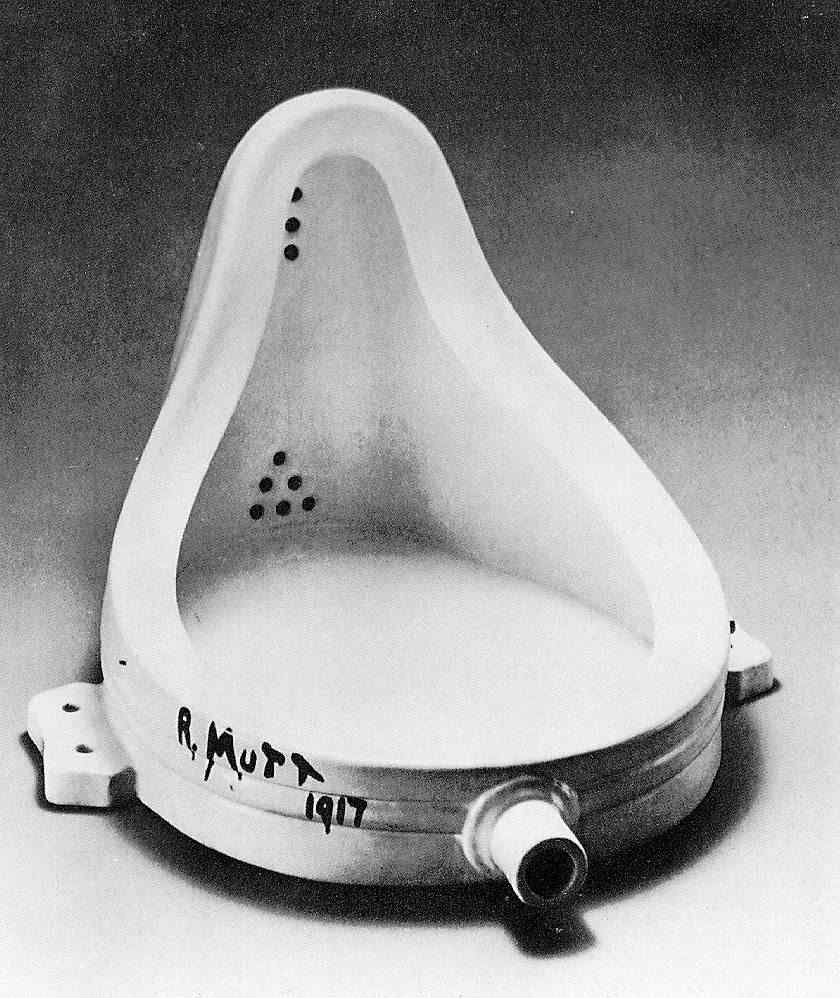
The idea of this picture as a parody is a little more complicated than Duchamp's imitation of the Mona Lisa. This work is a parody on art in general. The piece of "art" is simply and overturned urinal. In this picture Duchamp is poking fun at art in general, and what can be considered it. This is a parody on abstract art by questioning just how far-fetched and ambiguous art has become in the modern day.
Tuesday, March 19, 2013
Culture Jam
The intent of culture jamming is to reroute ones perception of an image changing/relating it to something entirely different. This is becoming widely popular. Culture jams usually focus of social and cultural issues and take popular and well known imagine and distort them in such a way to resemble something that was never originally intended. These images are becoming easier and easier to find, one that caught my eye is taken from ct4ct.com, here it is below.

This imagine is a fine example of culture jamming. What you see when you first look at this picture is very clearly what appears to be a baby sporting the infamous outfit of a KKK member. What some people may not realize is that this sculpture is created entirely using ancient artifacts. Many art connoisseur would be able to recognize the artifacts Fred Wilson used in this image, which he gathered from the Maryland Historical Society's museum in Baltimore. These objects never once implied a statement about racism, however with simple matter of placement the meaning of all those objects came together and now represent something of a totally nature. Who really knows what the artist is trying to say, but they could very well be implying something about the nature of racism, and if racism is a subtle theme in the ancient artifacts he reassembled. Or maybe he is trying to say that our children can easily be molded into racist if either left in the wrong hands, or allowed to be influenced by the wrong people. None the less, the culture jam as been put in effect. No person who knows of these artifacts will ever be able to look at these pieces of art again without their train of thought being rerouted to the racism image you know see here.
This imagine is a fine example of culture jamming. What you see when you first look at this picture is very clearly what appears to be a baby sporting the infamous outfit of a KKK member. What some people may not realize is that this sculpture is created entirely using ancient artifacts. Many art connoisseur would be able to recognize the artifacts Fred Wilson used in this image, which he gathered from the Maryland Historical Society's museum in Baltimore. These objects never once implied a statement about racism, however with simple matter of placement the meaning of all those objects came together and now represent something of a totally nature. Who really knows what the artist is trying to say, but they could very well be implying something about the nature of racism, and if racism is a subtle theme in the ancient artifacts he reassembled. Or maybe he is trying to say that our children can easily be molded into racist if either left in the wrong hands, or allowed to be influenced by the wrong people. None the less, the culture jam as been put in effect. No person who knows of these artifacts will ever be able to look at these pieces of art again without their train of thought being rerouted to the racism image you know see here.
Wednesday, February 20, 2013
Local Exhibitions
Over the next few weeks I plan to make a trip to one of many local art exhibitions and create a review. Finding local exhibitions is a lot easier than you may think, there are several in Ulster County alone. However, I don't plan to stay that local. The first exhibition I have in mind is just outside Ulster County, in Poughkeepsie. It's located in the Barret Art Center and it's going to be called A Celebration of Color; here's a link containing some information about it:
A Celebration of Color
Visiting this exhibition with my budget and lack of a car should be no problem. There is a bus that travels solely between New Paltz and Poughkeepsie a few times a day. The trip is under ten dollars and the bus station in Poughkeepsie is a short walk away from the Barret. This is likely the trip I'll make if my next option doesn't pan out.
That option is a chance I have to take a free trip to the MoMA in New York City. A friend of mine is a photography major, and stays very involved in the school's art department. Through him, I found out the school has already reserved a couple buses to bring whoever wants to go to the MoMA. I believe some seats are saved for art majors, but there should be enough left open for me to join in.
There are always a lot of exhibitions at the MoMA, the one I plan to critique is called Inventing Abstract. This exhibit explores the origins of abstract art, and displays select pieces from 1910-1925 which are believed to have started the abstract movement. Most of the art in this exhibition is also from Europe. I really hope this trip works out because abstract art contains most of my favorite pieces.
My final option would be to plan my own trip to the city and visit the Metropolitan Museum of Art and review one of the exhibitions they have there. A trip to the city really doesn't take much planning. On any given day, all I have to do is go down to the Trailways bus station and buy a round trip ticket to the city. This option is a bit more costly than going to Poughkeepsie, but it is much more worth it. In the MET I'd like to see an exhibition exploiting the art of Africa. This exhibit is supposed to contain artifacts as well as modern artwork and is meant to convey the dynamism of African artwork after 1910. Similar to the MoMA exhibit, the African Art showing will highlight pieces from 1910 up until the 1930's.
I plan for this trip to happen sooner rather than later, but knowing myself it may take a bit of time before I'm able to make this trek. However, I am more excited for this trip than I would be for ordinary school work; I've never been to any famous art exhibitions, and can't wait for my first time. When it's all said and done I'm sure I'll have a greater appreciation for artist and visual culture than ever before.
A Celebration of Color
Visiting this exhibition with my budget and lack of a car should be no problem. There is a bus that travels solely between New Paltz and Poughkeepsie a few times a day. The trip is under ten dollars and the bus station in Poughkeepsie is a short walk away from the Barret. This is likely the trip I'll make if my next option doesn't pan out.
That option is a chance I have to take a free trip to the MoMA in New York City. A friend of mine is a photography major, and stays very involved in the school's art department. Through him, I found out the school has already reserved a couple buses to bring whoever wants to go to the MoMA. I believe some seats are saved for art majors, but there should be enough left open for me to join in.
There are always a lot of exhibitions at the MoMA, the one I plan to critique is called Inventing Abstract. This exhibit explores the origins of abstract art, and displays select pieces from 1910-1925 which are believed to have started the abstract movement. Most of the art in this exhibition is also from Europe. I really hope this trip works out because abstract art contains most of my favorite pieces.
My final option would be to plan my own trip to the city and visit the Metropolitan Museum of Art and review one of the exhibitions they have there. A trip to the city really doesn't take much planning. On any given day, all I have to do is go down to the Trailways bus station and buy a round trip ticket to the city. This option is a bit more costly than going to Poughkeepsie, but it is much more worth it. In the MET I'd like to see an exhibition exploiting the art of Africa. This exhibit is supposed to contain artifacts as well as modern artwork and is meant to convey the dynamism of African artwork after 1910. Similar to the MoMA exhibit, the African Art showing will highlight pieces from 1910 up until the 1930's.
I plan for this trip to happen sooner rather than later, but knowing myself it may take a bit of time before I'm able to make this trek. However, I am more excited for this trip than I would be for ordinary school work; I've never been to any famous art exhibitions, and can't wait for my first time. When it's all said and done I'm sure I'll have a greater appreciation for artist and visual culture than ever before.
Monday, February 11, 2013
Appropriation In Art
There is a certain technique that is becoming increasingly popular in modern art. It is known as appropriation, which basically means to borrow the art work of others and use it to create your own. This remix video using appropriation from Winnie the Pooh and Apocalypse Now perfectly exemplifies this art form.
Sometimes, the agency a producer will use is to make a political statement but it could also just be for humor or the sake of homage to different artist. In this case I think a small bit of politics is involved but more so humor.
In my opinion humor mattered most: just in the sense that such a horrifically mature movie is being combined with one of the most innocent, good-willing T.V. shows. The way Todd Grahm (the producer) succeeds in his agency of humor is the extremely coincidental yet near perfect synchronicity of the movie's audio and the shows visual scene. Each cartoon character is matched up with a voice and together there is perfect context. Just look at the tightly wound rabbit who has the voice of a high strung machinist in the movie. Of course, a lot of the alussions would be lost on someone who isn't familiar with either of the two original medias, but there is can be more then just humor.
Another possible agency of Todd was a political one. In teaming up a show for children around the age of four with a graphic war there is a statement along the lines of the impossibility of being able to hide such horrific events from our children. I don't see this as Todd trying to desensitize and youth, only to infer the idea of a contradictory society, where children are being shielded from the horrors of the world. Maybe that's an appropriate thing to do, but seeing a show for toddlers with the audio of a rated R movie can be very thought provoking.
Sometimes, the agency a producer will use is to make a political statement but it could also just be for humor or the sake of homage to different artist. In this case I think a small bit of politics is involved but more so humor.
In my opinion humor mattered most: just in the sense that such a horrifically mature movie is being combined with one of the most innocent, good-willing T.V. shows. The way Todd Grahm (the producer) succeeds in his agency of humor is the extremely coincidental yet near perfect synchronicity of the movie's audio and the shows visual scene. Each cartoon character is matched up with a voice and together there is perfect context. Just look at the tightly wound rabbit who has the voice of a high strung machinist in the movie. Of course, a lot of the alussions would be lost on someone who isn't familiar with either of the two original medias, but there is can be more then just humor.
Another possible agency of Todd was a political one. In teaming up a show for children around the age of four with a graphic war there is a statement along the lines of the impossibility of being able to hide such horrific events from our children. I don't see this as Todd trying to desensitize and youth, only to infer the idea of a contradictory society, where children are being shielded from the horrors of the world. Maybe that's an appropriate thing to do, but seeing a show for toddlers with the audio of a rated R movie can be very thought provoking.
Monday, February 4, 2013
Studium and Punctum Breakdown
The terms studium and punctum were coined by Roland Barthes. The idea of analyzing a picture through these two means, to me, seems very similar to using denotation and connotation. Studium equals "meanings that are nameable", while punctum is supposed to "sting" the viewer. In other words, the punctum is what the picture means to those looking at it.
What's interesting is where these two means of analysis could lead. After observing a picture subjectively, each person will usually be influenced to form a specific "truth" behind the image. Truth is in quotations in order to represent that it may not be the truth at all, but only what the photographer hopes for us to believe.

In this picture the studium is simple, as it usually is. There is a bald man raising an assault riffle with one hand. He has sunglasses and a beard appearing to be around 40 years of age. On his gun there are orange letters, visibly reading "WE SHALL OVER-" Behind him is a crowd of people all holding up flags. In the skyline of the picture, right alongside the assault rifle there is a tall, thin white structure which is very recognizable the Washington Monument. The man has a very firm expression on his face.
The punctum perfectly overlaps the truth one would form after seeing this picture. However, understanding the punctum will explain why that truth is formed. I think this picture reminds most of its viewers of the same thing, the second amendment. This is clearly a man who thinks he deserves to have a gun. What makes this picture so convincing is the simplicity of the argument it inceptively forms. There is a man proudly waving a gun in front of a monument representing one of the most applauded characters in american history and his noteworthy accomplishments which turned this country into one were all people have the right to own a gun. Well, that amongst many other, if not more important than equally as necessary, freedoms. The words on the gun allude to the same argument. In the context, it's extremely likely that the whole quote reads "We shall overcome", referring to the African-American civil rights movement. The point is, those politicians who are trying enforce stricter gun control laws are oppressing liberties all men are entitled to. Oh, and the large protest in the back is pretty effective at provoking thoughts of revolution as well.
To me, a truly effective punctum should allow the truth taken away from an image to be accessible and straight to the point. This picture does that well. Whether your for gun control or against it, the picture absolutely says "Owning a weapon is our right as Americans". Of course, the opposing viewpoint is no where to be seen in this picture, but that may very well be the point. This picture was taken from the New York times, known to be very liberal in their opinions.
Monday, January 28, 2013
Patricia Piccinini: "The Young Family"

This is an extremely interesting piece, denotatively the picture depicts some sort of creature laying on her right side nursing two of her young, while another lies on it's back. The creature seems to be a peach color, with human and animal-like characteristics. The ears of the creature are long and droopy, like a dog. The face has a snout, but also very human-like wrinkles. Looking down the creature you can see it's arms, legs and hands are that of a human, and it's feet are also human hands. A pointed tail sticks out of the creature's lower back.The young, two of which are sucking on nipple-like utters on their mother's stomach, have the same traits as the larger creature.
Trying to look deeper into this picture can be confusing and discomforting. On a basic level, I think most people can agree that this creature is extremely unpleasant to look at. In other words, it's ugly. Possibly resulting from it's unfortunate features, the creature looks very depressed, judging by the look on it's face. However, this beast is displaying an act of life and love that many would describe as beautiful. Asking the question: can we find beauty in such a beast? On one level this work may be conveying some sort of inter-connectivity humans share with animal. However, it seems to be a bit darker, almost like it's a warning for what could one day be in this era of biological manipulation.
That final idea can be expanded on when giving this piece some intertextuality. Here are some related pictures.

.jpg)


Patricia Piccini is very interested in questioning the consequences of the scientific enhancement of life, specifically, the modification of human and animal life through things like stem cells and genomic imprinting. The first of these pictures is called still life with stem cells. Clearly, Patricia is trying to make the point that stem cell research is dangerous. The last picture was actually taken from my biology textbook, it's a pig injected with the genes of a jellyfish giving it a florescent glow created by Taiwanese scientist. The young family reminds seems to be another genetically modified creature showing just what humans may create if they follow down their current path.
Friday, January 25, 2013

Subscribe to:
Posts (Atom)